
For anyone following the rapid rise of AI news, it is hard not to get caught up in the hype and public anxiety about its use. Data illuminates both sides.
According to Pew Research and other polls, Americans’ views on AI have soured. A Quinnipiac poll finds that 70% think AI will cut jobs, 79% of respondents say they cannot trust AI, and more than 80% are concerned about AI. These numbers are hardly surprising. As I wrote in another Substack article, the share of American graduates securing full-time jobs has declined from 41% in the class of 2024 to 30% in the class of 2025, and the unemployment rate for new entrants in the United States rose to 13.4% in July 2025. According to the US Bureau of Statistics (2026), 1 in 4 unemployed people, or 1.8 million Americans, have been job searching for over half a year. Unfortunately, this high rate of unemployment has created an invisible underclass of workers who are training AI to replace themselves. Research also shows that AI enterprise systems have not reduced work but have intensified it. Public fears have been exacerbated by recent scandals, including Grok’s content generation and AI’s manipulation to evade shutdowns, increased energy prices associated with the rapid growth of data centers, and research showing a decline in human cognitive skills with persistent use of AI. A recent survey from the AI Policy Institute indicates that 72% of respondents prefer to slow AI development and that 82% distrust tech executives’ ability to regulate AI.
On the other hand, the promise that AI will revolutionize work and boost human agency by enhancing productivity and efficiency has fueled AI hype. This is especially evident in a surge in global private investment, estimated at $660 billion in 2026. In 2025, most funding came through major deals with five AI companies, including OpenAI, Anthropic, xAI, Scale AI, and Project Prometheus (backed by Jeff Bezos), which collectively raised $84 billion. There is excitement among tech leaders and investors, and despite anxiety about circular financing, executives are psyched about breakthroughs in AI scaling and enterprise strategies. According to the Wall Street Journal, AI is expanding within organizations, and top executives say these investments in AI are paying off.
Yet the Gallup survey indicates that only 12% of people use AI daily, with usage varying across industries and higher rates in finance, higher education, and technology. Experts, such as Jeffrey Ding, argue that we cannot realize the full productivity gains from AI without widespread daily adoption and deep integration of AI into business processes.
The data above paints a confusing picture. But what lies beneath it?
We interpret the emerging data as highlighting competing business and societal narratives about AI. Hence, we set out to scratch the surface and delve deeper into these narratives to explore human readiness for AI and the associated changes in the workplace. If organizations are investing billions of dollars in AI transformation, they surely want to improve productivity, efficiency, and other goals. We wondered whether their optimism aligns with the on-the-ground reality for workers and employees.
In our research, we conducted sentiment analysis by reviewing public reactions to AI-related reports, interviews, industry updates, and books on YouTube and X. In addition, we interviewed dozens of professionals across various industries.
What Did Our Research Uncover?
1. Five Distinct Attitudes Towards AI Adoption
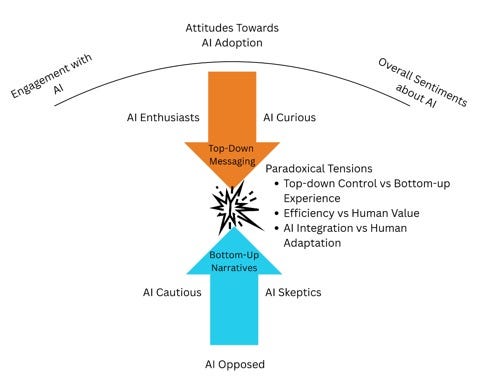
Our analysis of social media posts and interviews identified five distinct attitudes toward AI adoption, shaped by individual values, goals, and professional contexts (for example, tech leaders and consultants tasked with promoting AI were more favorable toward AI use). These included 1) AI enthusiasts, 2) AI curious, 3) AI cautious, 4) AI skeptics, and 5) AI opposed.
AI enthusiasts or AI-curious individuals are focused on innovation, efficiency, and potential breakthroughs. These attitudes were most often present in AI promotional content, often accompanied by optimistic, hopeful, and promising statements, such as “AI is changing the course of history,” “it is benefiting humanity,” and “it is making humans freer and more creative.” AI enthusiasts wanted to drive adoption, while AI-curious individuals showed interest in learning more and asking technical questions. Overall, these two attitudes represented top-down messaging aimed at promoting the use of AI.
In contrast, the other three public responses represented bottom-up narratives. AI-skeptics or AI-cautious cited concerns about job losses and other human costs, such as overreliance on AI, brain atrophy, further concentration of wealth, and loss of critical thinking skills. Overall, they wanted to slow AI development to make it more ethical and responsible. AI-skeptics largely doubted optimistic claims about AI. They engaged with AI more intellectually and asked: “Is it true? Where is the evidence?” Alternatively, they cited risks associated with AI use. AI-cautious, on the other hand, asked, “Is this safe”? They wanted to tread carefully in using AI to minimize risks. Over time, we observed a steady increase in AI-opposed individuals, who vehemently disapproved of or refused to use AI. Overall, these three attitudes represented bottom-up societal narratives of skepticism, caution, and opposition to AI. We found these bottom-up narratives to be powerful in shaping opinions on social media, with people coalescing around them to nurture, amplify, commiserate, and even soothe their fears.
2. Simultaneous Interplay of Backstage and Frontstage Resistance and Compliance
Further, interviews with professionals across various industries revealed some level of backstage resistance (i.e., unseen acts of opposition, dissent, and defiance against AI adoption and scaling efforts). Many interviewees reported distrust of AI and tech executives and expressed concerns about job losses and the rapid pace of development, which they viewed as showing little regard for the environment or even basic ethics. This, along with the rapid adoption in organizations without clear guidelines on how to use AI or how it will impact the nature of work in general and, more specifically, their own jobs and professions, exacerbated their fears. Many questioned the rapid development of AI and its usefulness, attesting to the widespread use of bottom-up narratives. Even participants who identified themselves as AI-enthusiasts in the interview raised the same concerns as those who saw themselves as AI-opposed or AI-skeptics.
As a result, AI use in organizations remains trivial, superficial, and non-transformative, largely due to distrust and negative sentiments, leading to inconsistencies between employees’ beliefs and perceptions and the organizational mandate for AI transformation.
The employee response to AI is nuanced and multifaceted, ranging from cognitively rationalizing its use (AI enthusiasts and AI-curious individuals) to rejecting it (AI skeptics), and is often accompanied by negative emotions, including plotting to delay its use, overtly or covertly. This ambivalence, or the conflicting, simultaneous feelings about AI, leaves people “on the fence” and prompts them to weigh reasons for contributing to the change against reasons to stay the same, driven by fear of the unknown or deep concerns about AI. Interviewees also described people’s resistance to AI in terms of frontstage and backstage interactions. Even those responsible for enabling AI (i.e., frontstage response) and tasked with developing strategies to train, educate, and motivate employees expressed doubts about its effectiveness (backstage, out of the public eye). They sometimes even found ways to circumvent or delay its use. Such seemingly contradictory actions (i.e., frontstage compliance and backstage resistance) affirm the importance of understanding the nuances and multifaceted aspects of resistance to AI.
3. Top-down and Bottom-up Narratives on a Collision Course
Sweeping top-down messaging in the media (e.g., “AI is super intelligence” or “the future of work is agentic”), along with rapid adoption efforts, have hardened the bottom-up narrative and put the two on a collision course. The result is employee pushback, including slowing, rejecting, and delaying large-scale, transformative AI adoption within their organization. On social media, in public discussions, and within organizations, this collision sparks friction, leading to the invalidation of these narratives, as each side outright denies the other’s truth, seeking to silence opposing voices and label them invalid. Overall, the collision of the two narratives highlights the proliferation of contradictions about AI, eroding their credibility and leaving the public confused or in disbelief. Both sides are clinging to their closely held perceptions rather than embracing the complex reality of AI development and transformation. This split is a major governance risk because it is undermining the already fragile trust between business and society.
What Can Business Leaders Do?
Slow down and pay attention to bottom-up narratives: The research highlights the immense power of grassroots narratives, which serve as the invisible architecture of culture and collective human psychology. Given the newness of AI, the fear of the unknown, the ubiquity of technological change, and the lingering distrust of tech leaders in particular, these grassroots narratives have shaped people’s mental frameworks and appear to guide their resistance far more effectively than top-down messaging. This society-business disconnect is real and has eroded societal trust. It should not be dismissed but addressed.
Our research participants shared that they were willing to embrace AI if there were greater transparency, stronger internal and governmental regulations, and more robust ethical safeguards. AI-cautious participants lamented AI’s inevitability but still worried about its unintended consequences for human connection, cognition, widening disparities, and the planet. With so many questions about AI unanswered, a lack of trust in businesses and executives, and the prevalence of a bottom-up societal narrative, participants felt a general unease toward AI adoption. This, combined with organizations moving full speed ahead in an AI ‘adopt’ mode without acknowledging or addressing employee unease, has created an unproductive situation.
Put the human back in AI transformation: All change initiatives evoke strong emotions. Research shows that when employees’ beliefs and perceptions do not align with the organizational mandate, inconsistency arises, leading to negative emotions such as shock, confusion, worry, indignation, annoyance, and apathy. Unaddressed inconsistencies in goals, norms, and values within the organization can cause employee disengagement and stall change efforts. Therefore, understanding people’s sentiments and attitudes and assessing their readiness for AI change are essential, as these factors influence the behavioral, cultural, and organizational components that can support or hinder AI adoption.
This research reminds us that AI deployment is not a simple plug-and-play technical solution, as participants’ sentiments stem from psychological and socioeconomic concerns rather than purely technical ones. Effective AI deployment will require implementing behavioral and cultural change and recognizing it as a complex outcome of daily human actions, such as complying, improvising, resisting, and sensemaking, that align with individual goals.
Don’t alienate people; address their concerns: Our study indicates both frontstage compliance and backstage resistance to the rapid development of AI, which is hindering its adoption within organizations. We argue that AI adoption need not be dictated by tech companies; rather, business executives should understand and address employee concerns and push tech companies to develop ethical, responsible AI focused on pro-worker AI and AI-human augmentation rather than mere substitution. They should, in fact, start by asking themselves and their employees which problems AI can help solve and which are better suited to human workers. When executives lead with “How can we use AI?” instead of “What problem are we solving?”, they often end up with AI tools that alienate employees.
Resolve the paradoxical tensions: Top-down messaging and bottom-up narratives create tensions that play out in paradoxical ways within organizations. On the surface, we see executives pushing for AI adoption and implementing AI scaling and enterprise strategies, while most employees feel threatened by it. Beneath the surface, we find a desire for top-down control, efficiency, and rapid AI integration, without fully recognizing the need to capture on-the-ground experiences, which place far greater importance on human value and adaptation. These tensions co-exist and, when managed well, generate intense creativity, learning, and resilience, but if mismanaged, can lead to stress, stagnation, and, through defensive cycles, reduced performance. A wealth of research indicates that organizations can succeed by resolving these seemingly opposing demands and tensions rather than choosing sides.
The unprecedented rise of AI has widened the long-standing divide between society and businesses, resulting in strong resistance to AI within organizations. To navigate AI disruption more effectively, business leaders must also consider the cultural and behavioral aspects of change efforts. This will begin with acknowledging the multifaceted nature of resistance and the power of bottom-up narratives, and will involve fostering trust through transparent decision-making, open communication, and dialogue, as well as re-skilling efforts. Unless organizations make genuine efforts to put the human back in AI development and transformation, the road to organizational AI adoption will be paved with resistance. This will damage ROI on AI, a major business endeavor critical to transforming AI from an “experimental expense” into a sustained enterprise strategy.
Note: A fuller version of this blog was presented at George Washington University’s Innovation Fest, Washington DC, on April 30, 2026. You may also check a shorter version of the article here at Business Coaching.
Acknowledgments: I am grateful to David Timis (Senior Fellow in AI Governance, Global Governance Institute, Brussels, Belgium) and my research team at GW, including Dr. Kevin Knudsen, Ivy Clem, and Mengying Cao, for their contributions and support for this research.
Also available as a Medium article here: https://medium.com/@shaistakhilji/research-note-ai-society-and-the-changing-nature-of-work-9d036de8338b